Heritage Regulations & Portico Preservation in Italy
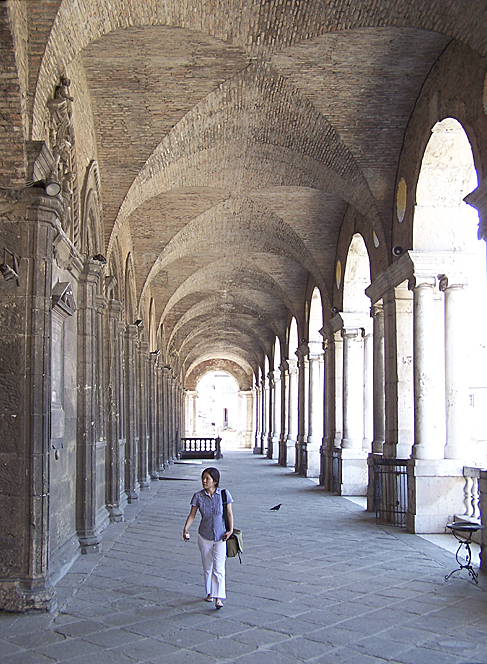
Upper loggia of the Basilica Palladiana, Vicenza (from 1549). Photo: Dogears / Wikimedia Commons (CC BY-SA 3.0)
The preservation of historic porticoes and loggias in Italy operates through several overlapping layers of regulation. At the national level, Legislative Decree 42/2004 (the Codice dei Beni Culturali e del Paesaggio) establishes the principal framework for the identification, protection, and management of cultural property. At the municipal and regional level, Piano Regolatore Generale (PRG) instruments and their more recent equivalents (Piano Urbanistico Generale) define what alterations are permissible in historically significant districts. Where international recognition applies — as in the case of UNESCO World Heritage Sites — buffer zone regulations add further constraints.
Legislative Decree 42/2004: The Core National Framework
Under D.Lgs. 42/2004, cultural property (beni culturali) includes immovable items of historical, artistic, archaeological, or ethno-anthropological interest. Buildings dating from before 1945 and belonging to public entities are subject to an automatic presumption of cultural interest, while privately owned structures require a formal dichiarazione di interesse culturale issued by the competent Soprintendenza.
Once a building — or an ensemble of buildings, as is common in historic centres — is subject to a declaration, any intervention affecting its external appearance, structural elements, or interior configuration requires prior authorisation (autorizzazione under Art. 21) from the Soprintendenza Archeologia, Belle Arti e Paesaggio. This applies directly to loggia and portico structures that form part of protected buildings or that are themselves declared cultural property.
The distinction between restauro (restoration), manutenzione straordinaria (extraordinary maintenance), and ristrutturazione (restructuring) is not merely terminological under Italian law — it determines which type of administrative authorisation is required and which technical specifications apply.
Landscape Protection and the PRG
Loggias and porticoes located in areas declared as landscape assets (beni paesaggistici) under Part III of D.Lgs. 42/2004 are subject to an additional layer of assessment. Many Italian historic centres are simultaneously subject to both cultural property protection and landscape protection, which requires authorisations from both the cultural heritage and planning branches of the Soprintendenza.
Municipal planning instruments (PRG, PGT, or equivalent) typically define the historic centre as a zone subject to specific urban conservation requirements. In these zones, alterations to porticoed ground floors are often explicitly addressed: portico widths, pavement materials, column sections, and vault configurations may be prescribed or protected through conservation schedules annexed to the planning document.
Bologna: A Case Study in Portico Regulation
Bologna's portico network extends across more than 38 kilometres of the historic centre and surrounding hillside. In 2021, the city's porticoes received UNESCO World Heritage inscription as a serial cultural property. The management of this inscription involves coordination between the Municipality of Bologna, the Soprintendenza, the Emilia-Romagna Region, and the national MiC.

Portico di San Luca, Bologna. Photo: Vanni Lazzari / Wikimedia Commons (CC BY-SA 4.0)
The Municipal Urban Plan (Piano Urbanistico Generale, approved in 2021) introduced specific prescriptions for portico conservation in the historic centre, distinguishing between:
- Porticoes subject to restauro conservativo (conservative restoration), where no alteration to structural or decorative elements is permitted;
- Porticoes in degraded condition subject to risanamento conservativo, where reversible interventions are permitted to restore functionality;
- Porticoes in partially demolished or significantly altered condition where reconstruction based on documented evidence may be authorised.
Private owners of porticoed buildings in Bologna are obligated to maintain the accessible public portion of the portico — the covered passage itself — in a safe and navigable condition, even though the structural ownership of the columns and vaults may rest with the private building owner. This dual-regime situation (private ownership, public-use obligation) has generated recurring disputes over maintenance cost allocation, which have been addressed through municipal guidance issued by the city's technical offices.
UNESCO Buffer Zones and Management Plans
For Italian historic centres inscribed as UNESCO World Heritage Sites, the buffer zone defines an area around the inscribed property within which all planning decisions must be assessed for their potential impact on the Outstanding Universal Value (OUV). The buffer zone does not create additional categories of prohibited intervention but requires the competent authority to consider OUV impact in the decision-making process.
Management plans accompanying UNESCO inscriptions — such as the management plan for the Porticoes of Bologna, or those for the city of Vicenza and the Palladian Villas — provide operational frameworks for coordinating the activities of different administrative bodies. These plans are reviewed periodically and form the basis for periodic reporting to the UNESCO World Heritage Committee.
| Regulatory level | Instrument | Applicable to porticoes |
|---|---|---|
| National | D.Lgs. 42/2004 | All declared cultural property |
| National / regional | Landscape plans (PTPR) | Porticoes in landscape-protected zones |
| Municipal | PRG / PGT conservation schedules | Porticoes in designated historic zones |
| International | UNESCO buffer zone norms | Porticoes in WHS buffer areas |
Seismic Regulation and Structural Interventions
Italy's position in a seismically active zone means that structural interventions on historic porticoes must comply with technical norms for constructions in seismic zones, currently governed by the Norme Tecniche per le Costruzioni (NTC 2018, Ministerial Decree of 17 January 2018) and by the Linee Guida per la valutazione e riduzione del rischio sismico del patrimonio culturale (2011, updated). These guidelines establish a graduated approach to seismic assessment of cultural heritage buildings that is compatible with conservation requirements, distinguishing between interventions aimed at miglioramento sismico (seismic improvement, which does not require compliance with full NTC standards) and adeguamento sismico (full seismic adaptation, which does).
In practice, most interventions on historic loggias and porticoes are treated as seismic improvement rather than full adaptation, given the constraints imposed by heritage protection. The specific technical approach — whether consolidating existing mortar joints, installing discrete tie-rod systems, or injecting micro-piles around column bases — is determined case by case in consultation with the Soprintendenza.